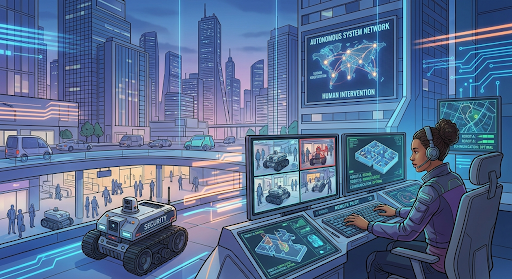
Old security methods are struggling to keep up with new, complex threats and environments. Static cameras and human patrols are important, but they often don’t give enough coverage to fully protect people and things. This has paved the way for the rise of autonomous security robots, both ground-based and aerial, powered by advanced technologies like artificial intelligence, machine learning, and computer vision. These robots promise enhanced efficiency, persistent monitoring, and wider coverage. Remote pilots bring out the best in them by guiding them wisely. This article explores how these remote pilots act as the vital human-in-the-loop, transforming autonomous robots from sophisticated tools into indispensable components of modern security programs, enabling them to navigate and secure the most complex environments.
The Autonomy Advantage: Revolutionizing Security Operations
Robots help keep places safe by patrolling on the ground and flying overhead to watch what’s going on.
Autonomous security robots are rapidly reshaping the landscape of physical security by leveraging cutting-edge technologies to perform tasks with a level of precision and endurance previously unattainable. These robots use strong AI and machine learning to understand and react to their surroundings. Computer vision, in particular, allows them to identify objects, recognize patterns, and understand scenes with remarkable accuracy, transforming raw sensor data into actionable intelligence.
These capabilities translate into tangible benefits for security teams. Robots on the ground can carefully watch over set paths, going along big walkways and fences. They notice things that people might miss because they get tired or distracted. Meanwhile, autonomous drones, also known as Unmanned Aircraft Systems (UAS), offer unparalleled aerial awareness, providing a bird’s-eye view of sprawling industrial sites, critical infrastructure, or large event grounds. They can quickly check things out, spot possible break-ins, and keep an eye on places that ground patrols can’t reach. In big warehouses, both ground robots and small drones work together to cover all areas and improve security. Combining different robots makes a stronger security system that can watch things all the time.
When Autonomy Meets Complexity: The Limits and the Imperative for Human Oversight
While the advancements in artificial intelligence and machine learning have brought autonomous robots to the forefront of security, pure autonomy still faces significant limitations, especially in dynamic and unpredictable settings. Complex places with quick changes, surprises, or strange landscapes can be tough for even the smartest AI. An anomaly spotted by a robot’s camera could be a real danger, a mistake caused by weird lighting, or just something harmless in the environment. Without human judgment, the robot’s response or lack thereof could be suboptimal.
This is where the concept of the “human-in-the-loop” becomes paramount. Remote pilots are not merely operators; they are intelligent supervisors who provide the critical contextual understanding, nuanced decision-making, and adaptability that autonomous systems currently lack. They help connect how robots see things to how they act, making sure the robots work well and are safe. For instance, a robot might trigger a security alarm based on its programming, but a remote pilot can quickly assess the situation through multiple video feeds and determine if intervention is truly necessary, or if it’s a minor, non-threatening event. This human oversight is essential for managing nuanced situations, mitigating risks associated with autonomous errors, and ensuring that the robots are aligned with the broader objectives of the security program.
The Remote Pilot: A New Frontier in Security Operations
Being a remote pilot for security robots is a fast-changing job that needs special skills, awareness, and good thinking. The pilots are key in linking robots’ advanced skills with smart decision-making. They use advanced control panels that show live videos from many robots, along with sensor information and alerts made by AI. It helps them see everything from above and know what’s happening on the ground, so they get the whole picture.
Pilots can handle tough situations by using different views, like seeing from a robot’s perspective, to get a close-up look at tricky areas. This helps a lot when checking strange things near fences or in small spaces inside warehouses. Drone pilots are now often in charge of managing groups of drones, making them work together to cover big areas or quickly deal with incidents. They work with Edge AI systems, like NVIDIA’s Jetson platform and Intel’s EdgeRunner AI. These edge computing solutions enable robots to process data locally and rapidly, feeding refined insights to the remote pilot for faster decision-making, whether it’s adjusting dynamic patrol routes or initiating a response.
Bridging the Gap: Remote Pilot Workflows in Action
People controlling security robots from afar have busy tasks, showing how human skills can make robots work better. Consider a scenario on a large industrial campus. A ground robot following its patrol paths finds something unusual near a restricted area. The AI detects a possible breach and sends an alert with related sensor data and some video feeds. The remote pilot watches the live video feeds and can switch to a First-Person View (FPV) to get a better look if needed.
The pilot could use a self-flying drone to quickly see the area from above, helping the ground robot see more. If needed, the pilot can use a group of drones to circle the area and watch everything. They can look up current threat info or use a digital library with site plans and past incidents to get context, by using systems that help find and manage documents. This method lets us quickly make smart choices about access control, like locking certain areas or sending out security teams. Remote pilots use filters to manage info from ground robots and drones. They also use fast Edge AI tech, like NVIDIA Jetson or Intel EdgeRunner, to keep autonomous systems working their best in security setups.
Strategic Impact: Elevating Security Programs
Remote pilots working with self-driving security robots improve and streamline security programs. Using robots to help human security teams gives organizations better security than old methods. You can see better, spot threats earlier, and react faster to security issues with this improved view.
Remote pilots ensure that autonomous systems are not just tools, but integral parts of a comprehensive strategy. They can dynamically adjust patrol routes based on real-time intelligence, optimize coverage along perimeter walkways and fence lines, and direct robots to investigate suspicious activity that might otherwise go unnoticed or be delayed. Being prepared helps us rely less on emergency alarms and makes our security stronger and cheaper. Furthermore, the data collected and managed by these systems, from detailed video feeds to anomaly logs stored in digital libraries, provides valuable insights for ongoing threat assessment and future planning, reinforcing the overall strategic value of the security infrastructure.
The Future of Human-AI Collaboration in Security
Remote pilots and security robots working together is not just a trend; it’s key to future security. As AI, machine learning, and computer vision keep improving, robots will become more independent and able to do more tasks on their own. People will still be needed to watch over things, especially in tricky and unpredictable situations. Remote pilots will move from hands-on control to overseeing and managing tasks more intelligently.
This evolution is supported by ongoing research and development. Experts like Pramod Raheja share useful ideas about how autonomous systems can be used now and in the future. Technical reports and academic publications, such as those found in IEEE Trans and J. Field Robot by researchers like Mejias L. and Diguet J., continually push the boundaries of what’s possible. AI systems will likely get better at helping remote pilots by first checking data, suggesting the best actions, and handling routine tasks, so pilots can focus on important decisions and tough problems. Human-AI teamwork is getting better and will make security stronger and smarter in the future.
Conclusion
Remote pilots working with security robots is a big step forward in protecting tricky places. Robots get really good at patrolling and using drones by learning with AI and computer vision. However, it’s the smart decisions of remote pilots that really bring out their full potential. These pilots, leveraging video feeds, First-Person View, and sophisticated Edge AI platforms such as NVIDIA’s Jetson and Intel’s EdgeRunner AI, provide the essential layer of oversight needed to navigate unforeseen challenges and optimize responses.
Remote pilots help improve security by filling the gap between full autonomy and security goals. They make it easier to see what’s happening, manage access better, and strengthen security programs. They turn robots into smart tools that help humans keep things safe and manage risks in difficult areas. Using remote pilots and robots in security work is the future, especially as the area grows with new ideas and expert input.
Keywords:
Remote Pilots Support
Autonomous Security Robots – 260 Volume
Remote Pilot – 260 Volume
Anchortext: Robots